
The Fault Line
On accumulated pressure and structural failure

The Fault Line
Nothing begins at the moment it breaks.
By the time the surface gives way,
the shift has already traveled miles beneath it,
stone pressing against stone,
edges grinding in the dark
beyond observation.
Above it, everything appears normal.
Floors remain level.
Walls keep their lines.
Glass rests undisturbed in its frame.
Messages still get answered.
Plans remain in place.
Nothing is canceled. Nothing is named.
Even the air carries a kind of stability,
as though the ground itself
is capable of sustaining what has been built upon it.
But underneath,
weight is redistributing.
Pressure leans,
then recalibrates,
then settles again
into positions that do not fully resolve.
A pause goes unaddressed.
A correction withheld.
A moment passes
because it is easier to let it pass.
Not enough to register as failure,
only enough to persist.
And so it continues.
Days accumulate.
Sometimes years.
A table remains in place.
Footsteps repeat their pattern.
A life arranges itself
over a structure already in motion.
There is no immediate signal for this.
Only a gradual tightening.
A seam drawn thinner
through repeated accommodation.
A sentence lands differently than intended.
A look lingers a second too long.
Until one moment
can no longer be absorbed.
It is rarely the most dramatic moment.
Only the one
that lands last.
A shift that does not return.
A line that does not close.
A fracture that completes itself
without consultation.
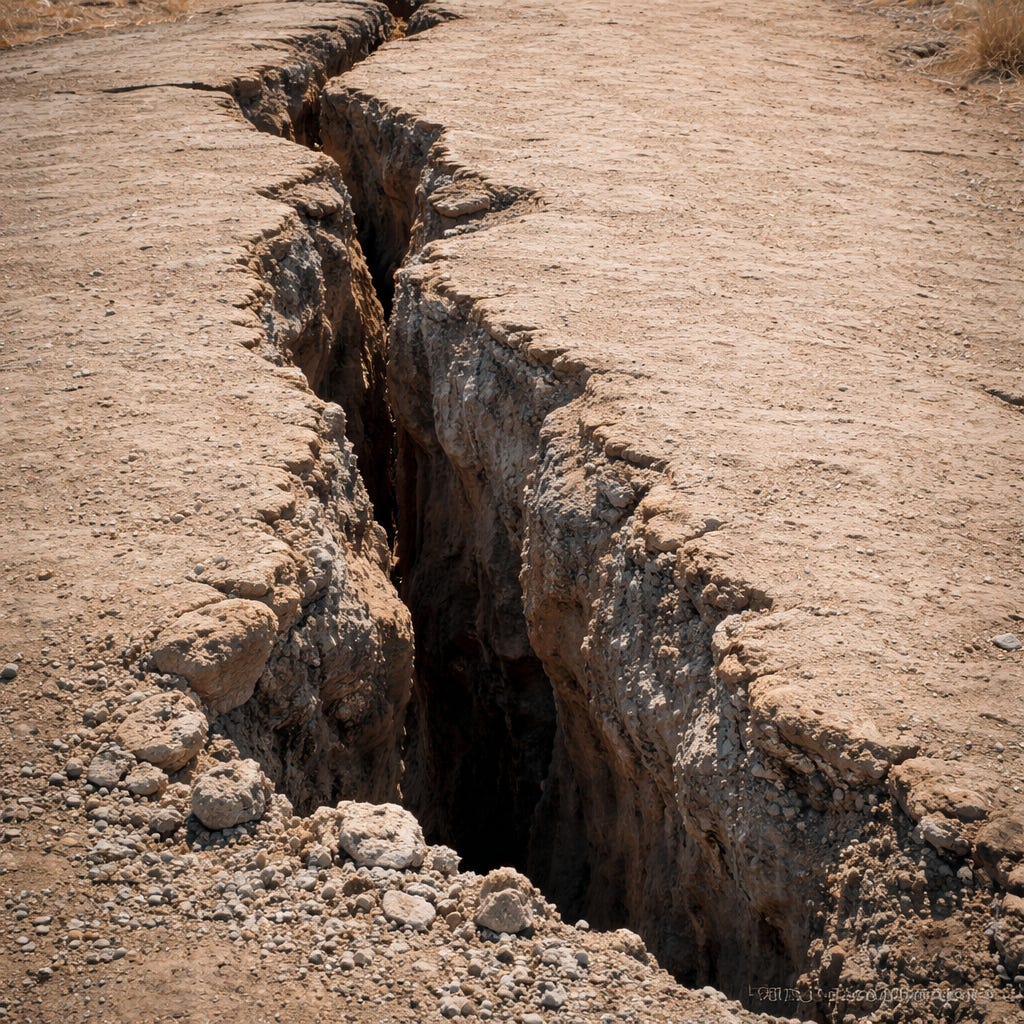
The ground responds
to the totality of what it has been holding.
The surface opens clean at first,
then unevenly,
then without symmetry.
What stood begins to tilt.
What felt stable
loses its reference point.
Dust rises.
Light enters
where no opening previously existed.
And within that opening
is the structure of the event.
The rupture did not originate here.
It was carried forward
through each small accommodation,
each redistribution of weight,
each decision to hold tension in place
rather than reconfigure it.
Afterward, there is a search
for a singular cause.
A point of origin.
A moment that could have been altered.
But the fracture resists that logic.
There is no single point to locate,
only an extended history of movement
that remained out of view.
The ground does not fail at random.
It follows accumulated pressure
to its structural conclusion.
And the line that opens
is not newly formed,
only newly visible,
having reached the threshold
where it can no longer remain contained.
Reflection
Fault lines do not appear without precedent.
They are set in smaller adjustments, in pressure absorbed and realignment deferred.
Nothing signals urgency.
The system continues which is what makes it credible.
Intervention requires disruption while stability still appears intact.
And so it holds, until holding becomes the failure.
By the time the fracture is visible, it is no longer forming.
It is completing.
© Monica A Leyva | Layers of Shimmer
The imagery is absolutely stunning, beautiful and evocative!!
This could be a metaphor for so many things.