
Rivers of Memory
An exploration of how memory moves through the body like water through a river channel.

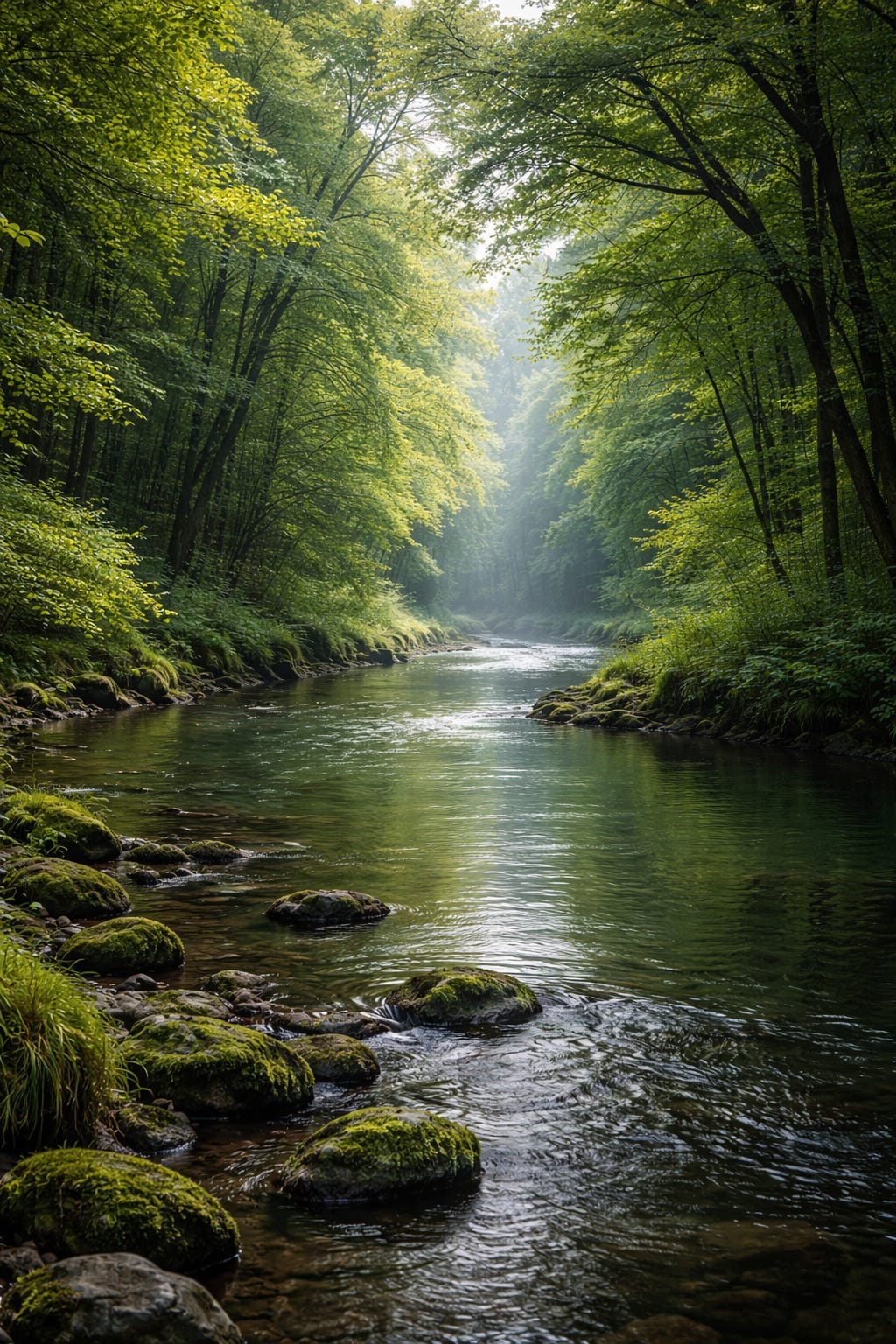
Memory rarely behaves like an archive. It behaves more like a river.
This piece began with a writing prompt shared by my friend Monica Fernandes, whose encouragement has been a steady presence in my writing life on Substack. Her generosity and belief in my work have shaped more than she knows.
Some rivers begin with rain. This one began with her words.
Rivers of Memory
The river carries what the mind pretends it released
Cold syllables slip between stones
Silt clouds the ankles of thought
Entry requires weight
The surface holds reflective grammar
Sky fractures into shards
Light stutters on moving skin
Each ripple revises perception
Sound gathers within the channel
Current strikes root
Stone answers with echo
Silence arrives with texture
Iron and leaf ride the breath
Weather gathers in the mouth of the valley
Memory enters through the air
The body receives history
Palms return carrying moss
History leaves residue
Proof dissolves
Contact remains
What moves forward carries no water
only the pressure it leaves in the body.
Reflection
The surface of the river functions as a site of unstable reflection. Light fragments across moving water, producing a visual grammar shaped by distortion and velocity. Under these conditions, perception becomes interpretive rather than representational. Meaning emerges through movement. The scene resists fixation. The observer participates in the deformation of what appears stable.
Sound structures the river’s temporal field. Current striking root and stone generates a low, continuous percussion. Silence carries material density. Quiet registers as pressure rather than absence. The auditory field becomes an index of friction, where force meeting resistance produces intelligible rhythm. Memory accumulates through these patterned impacts, recording duration through repetition.
Memory enters the body through sensation prior to narrative framing. Iron and leaf travel with breath. Weather settles into the bloodstream through scent. The body receives history through taste, temperature, and texture before language assigns coherence. Tissue absorbs residue. Nerve conducts pressure. Sensory contact precedes conceptual organization.
The body functions as an archive of crossings. Cold settles into joint and tendon. Skin carries the trace of grit. Breath adjusts to the labor of current. Memory forms through embodied negotiation with force rather than through retrieval of stable records. Experience persists as pressure patterns across tissue, shaping posture, gait, and attention.
Rivers collect residue from surrounding environments. Runoff from fields, rust from bridges, ash from distant fires enter the current and alter its chemistry. Memory exhibits similar accumulation. Fragments of speech, heat from vanished rooms, residues of prior contexts travel together through a shared channel. These materials modulate the flow of perception. The past alters the velocity of the present.
Each return to memory entails exposure to a system shaped by prior contact. Footing shifts as sediment rearranges. The channel deepens where weight repeatedly settles. Balance develops through repeated loss of balance. Endurance develops through yielding to force. The process produces consequence rather than consolation.
Remembering involves entering a moving system that reshapes its carriers. The river writes through those who step into it. Erosion marks the cost. Weight marks the trace. What moves forward carries pressure through the body.
Memory operates as a fluvial system rather than a static archive. It transports material loosened by experience, reshaping it through pressure, repetition, and contact with resistance. Each return to the same narrative channel alters the channel itself. The subject who enters memory encounters a system already shaped by prior crossings. Attention bends where weight has settled before.
Thank you @Gary L Taylor for reading and restocking this.
Thanks @Óðr Sierra Sierra for the restack