
My Father, the Immigrant

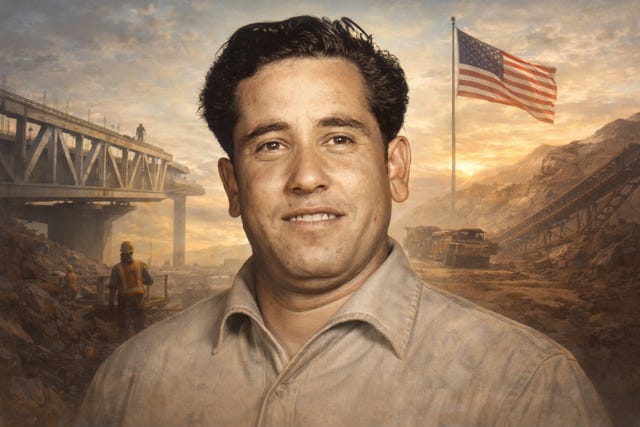
My father’s name was Juan Francisco Leyva.
He was born in Guadalajara, Mexico, and like many who came north, he did not arrive chasing an abstraction. He came for work. For stability. For the possibility of building something that would outlast him.
He labored in the mines of Utah.
He helped build bridges in California, structures meant to hold weight, to span distance, to last longer than the men who assembled them. He worked so hard in building and growing this country’s infrastructure that he eventually became a work foreman, entrusted not only with labor, but with leadership, safety, and responsibility. Authority did not come to him by title alone; it was earned through years of consistency, dedication and endurance.
He paid taxes. He obtained his green card and retired with Social Security. He contributed, quietly and steadily, to a country that often speaks about people like him without ever learning their names.
He was not alone. Many of his relatives followed similar paths. They worked. They studied. They built businesses. They became doctors, nurses, attorneys. They raised families. They paid into the same systems they would one day rely upon. They retired with Social Security, not as beneficiaries of generosity, but as participants in a contract they honored over decades.
My father loved his children.
Not abstractly. Not conditionally. He was proud of our successes. He measured his life not by recognition or status, but by whether his children stood taller, safer, and with more choices than he had been given.
He was not a perfect man.
That truth matters to me because it keeps this from becoming mythology. He had limitations. He made mistakes. He carried the weight of his own history in ways that sometimes spilled outward. But imperfection does not negate contribution. Complexity does not cancel worth.
His legacy is more than a man who crossed the border illegally.
He fought for the American dream with his labor, his leadership, and his willingness to begin again in a place that did not always welcome him. He worked. He stayed. He took responsibility for others. He believed that effort mattered, more importantly, even when recognition did not follow.
He is the reason I exist.
Not only biologically, but historically. My education, my profession, my voice, my citizenship, my sense of responsibility, all of it traces back to a man who crossed a border with calloused hands and an unremarkable hope: that his children might stand on firmer ground than he did.
His legacy is written into the ground we stand on and the lives that rose because he did.
I am honored to be his daughter.
This is a beautiful piece, Monica. I’ve lived at the border for many years and know well how braided the threads are between US and Mexico. In so many ways, the cultures are completely intertwined and I’m so glad for voices that speak about the significance of the Hispanic and Latino presence🙏
Thank you for sharing this, Monica. It's a beautiful reminder that legacies are built, brick by brick and bridge by bridge. Coming from a family of immigrants, and having written extensively about our own migration and struggles, your father’s story is a powerful testament to the quiet dignity of that familiar hard work.