
Community in Practice
Toward an Ethic of Collaborative Attention

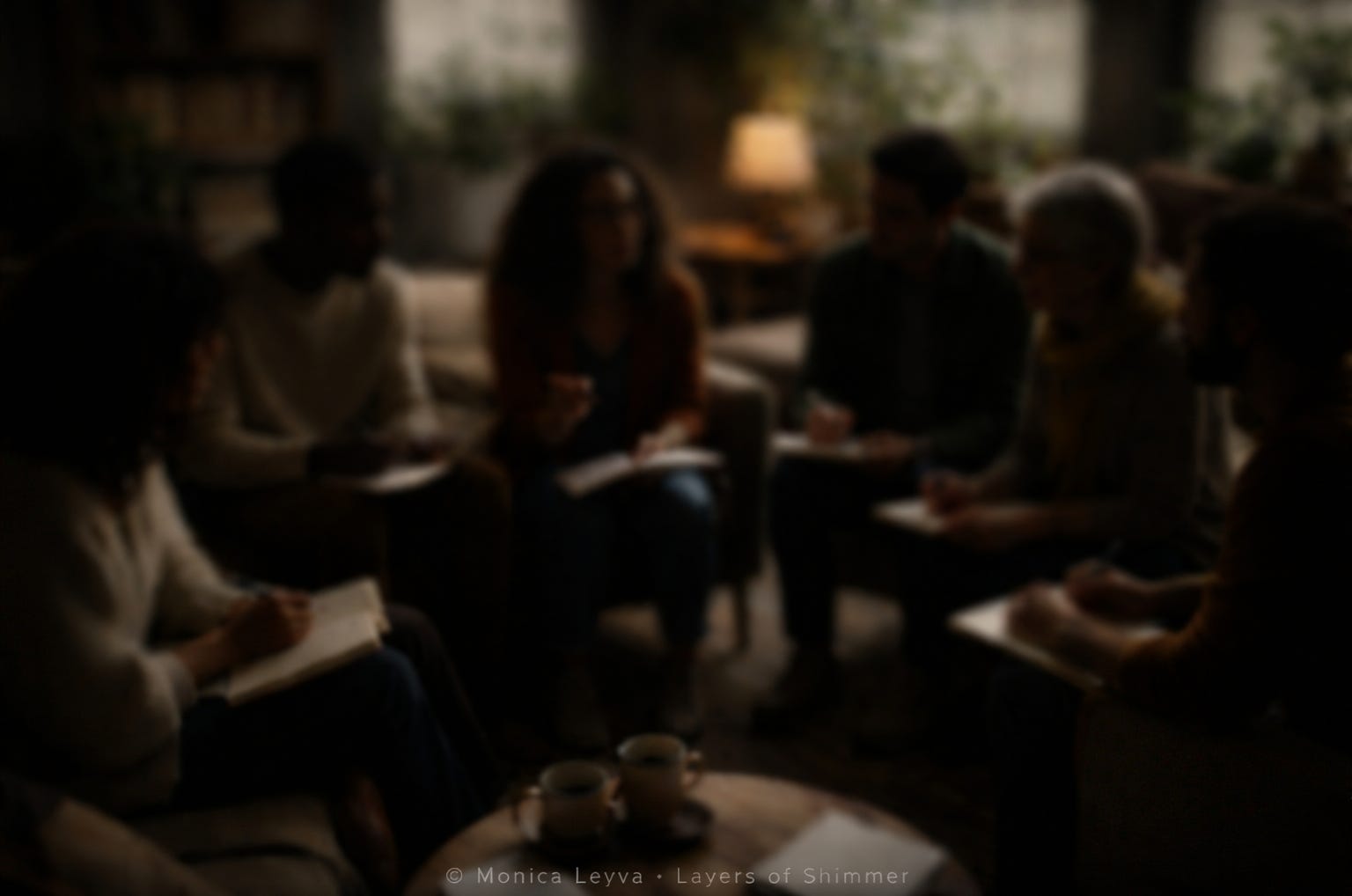
Community is a discipline.
It requires attention. It asks for reading as an act of care, listening as a form of labor, and recognition as a practice of ethics. In collaborative spaces, meaning is not produced in isolation. It is shaped through witnessing. What we choose to read, to amplify, and to hold with seriousness becomes part of how knowledge circulates. This is not neutral. It is a set of choices that reveal what we value.
To practice community is to resist extraction.
To refuse flattening.
To remain accountable to the singular voice while participating in the collective.
This is not about platform.
It is about posture.
Beyond Platform: Community as a World Practice
This practice does not belong to Substack.
It is merely rehearsed here.
What we are learning to do in this space is transferable:
to read without extracting,
to respond without flattening,
to collaborate without consuming the source of another’s voice.
This is not a writing strategy.
It is a way of moving through the world.
The same discipline applies beyond creative spaces.
In families.
In institutions.
In leadership.
In research.
In disagreement.
To practice community is to approach others as irreducible.
To refuse the convenience of simplification.
To remain accountable to singularity while working toward collective coherence.
If this posture can be sustained in public discourse,
in professional collaboration,
in ordinary encounters with difference,
then community becomes more than a digital phenomenon.
It becomes an ethic of relation. A method of living alongside others without rendering them usable.
This is how we practice a world that does not depend on erasure to function.
Community, Practiced
We arrive carrying unfinished sentences,
drafts shaped by solitude and doubt.
Each voice tests the air of the room
to learn how resonance forms.
Reading becomes a method of care.
Attention becomes an ethical act.
We annotate each other into clarity,
discovering that thought strengthens
when it is witnessed in the presence of others.
The solitary mind loosens its grip on authorship
and allows meaning to be co-constructed.
What begins as one articulation of risk
multiplies through recognition.
Support circulates as practice, not performance.
Collaboration teaches us to hold difference without flattening,
to build without extraction,
to grow without consuming the source of growth.
Here, the individual voice does not vanish.
It becomes legible within a collective.
What rises is coherence.
One voice becomes many
and the many learn how to speak
without losing the singularity of their breath.
The Witness Method™
The Witness Method™ asks three things of me as a reader and collaborator.
Truth, in how faithfully I represent another’s work.
Clarity, in how I name what I am seeing without projection.
Compassion, in how I hold the vulnerability of shared language.
To witness is not to interpret someone into alignment with my own narrative. It is to remain present to the integrity of their voice while acknowledging how it moves me. When practiced consistently, this posture scales into an ethic of relation. It resists extraction by refusing to treat another’s labor as material for my own authority. It resists flattening by preserving singularity within collective coherence.
This is how individual voices remain intact inside a collective.
This is how growth occurs without consumption.
This is how community becomes practice rather than claim.
And how practice becomes a way of being with the world.
I practice this because I have been harmed by spaces that confuse attention with ownership.
© Monica A Leyva · Layers of Shimmer
If you are new you might like this post:
Active listening, a too often forgotten but integral part of communication.
"confuse attention with ownership" ... beautifully said!
I am "stealing" you that phrase ;-) ... love it